
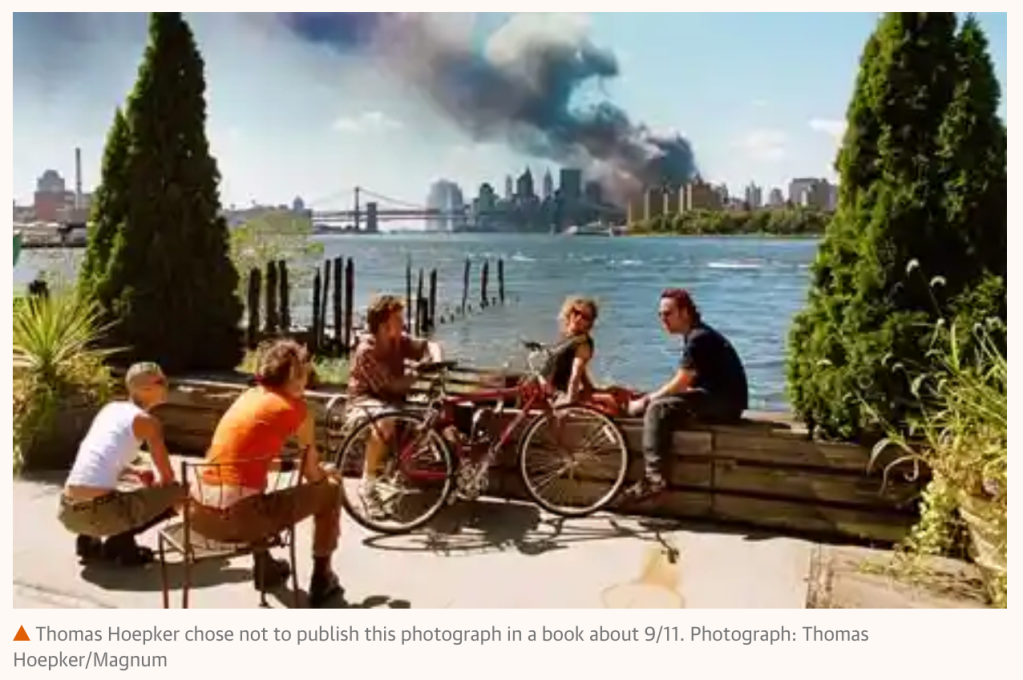
When looking at Hoepker’s image, the first thing that stood out to me was the thick smoke billowing from the buildings. Next, the group of people in the foreground are brought into view, all seemingly in relaxed poses. Last, the bright and sunny day is noted against the contrast of the dark background. What I interpreted the meaning of this photo to be is a metaphor for how people are focused on themselves and are ignorant of the events happening in the world around them. After reading the article, The Meaning of 9/11’s Most Controversial Photo by Jonathan Jones, I realized the photo was actually related to the tragic event that happened many years ago. Examining the photo, it is evident that the photographer wanted to capture a moment that was unique yet horrifying. The burning buildings as well as the group of smiling, seemingly happy people are the focal points of the picture, which conveys a message of indifference to the tragedy behind them since they are safe from harm’s way. It is also important to ponder on the fact that the photographer did not release this photo until years after it was taken. At the time, the photographer did not feel the picture was appropriate for the tragic event and put it in a box of rejects. Frank Rich, a member of the New York Times, describes the people in the picture as being carefree and a representation of how America moves on from events quickly. Two of the group members in the picture were also contacted, and they gave a different account from what the photo exhibited. Instead, they claimed they had already witnessed the buildings exploding from his apartment, and had merely come closer to the waterfront in a state of shock and disbelief. They went on to explain how this photo is actually a group of strangers comforting one another on the catastrophe behind them, not relaxing in the sunshine. There is only one image, but these varying perspectives tell completely different stories.
The multiple perspectives regarding this photo support Plato’s concern with imagery speaking the truth. It is difficult for us as the viewers to dig deeper into the context of imagery, and usually we are content with scanning the image and coming to our own conclusions instead of conducting further research. While the photographer claims he took the picture quickly and while in the midst of trying to get closer to the tragedy, just looking at the photo does not convey that message. This photo does not tell the truth of the situation, but instead creates an alternative narrative to the “reader” to be interpreted. This picture also supports Plato’s idea of iconophobia and how there are many perspectives on what the “truth” of the image actually is. Our society is heavily overrun by imagery, and there is not always context attached to these pictures. This encourages inaccurate analyzation of the what the truth behind an image is, and can also lead to the mass circulation of misinformation. Since the internet is where most people gather their information and anyone can post information to the internet, it is understandable why deception is a common occurrence. Plato’s concerns are relevant because some of these cases can turn dangerous, when the misinterpreted “truth” leads to great misunderstandings. While the 9/11 photo does not create a deadly misunderstanding, it still does not speak the truth. This is why conducting research should be motivated in our culture. By doing this we can not only contest the rise of misinformation, but encourage the proper thought process behind careful analyzation and interpretation.
Works Cited
https://www.theguardian.com/commentisfree/2011/sep/02/911-photo-thomas-hoepker-meaning
https://slate.com/culture/2006/09/frank-rich-is-so-wrong-about-that-9-11-photograph.html
https://slate.com/culture/2006/09/i-took-that-9-11-photo-frank-rich-wrote-about.html

 Exploring Writing